Sleep Specialist Explains: “If You Wake Up With Back Pain Every Morning, Your Mattress Surface Could Be Making It Worse”
Why adults over 45 wake up stiffer and more sore than when they went to bed, and the affordable mattress-surface upgrade thousands are trying before spending $2,000 on a brand new bed.


If you're reading this because you woke up this morning, shuffled to the bathroom, and had to brace yourself against the wall while your back slowly unlocked...
If you have spent seven or eight hours in bed, only to feel more worn out getting up than you did going to sleep...
If the first twenty minutes of your morning are now just about waiting for your hips, lower back, and shoulders to stop aching long enough to get dressed and make coffee...
Then I want you to read the next few minutes carefully.
Because I think most people are asking the wrong question about morning back pain.
I hear the same advice every week.
Stretch more.
Lose weight. Try heat. Try ice. See a chiropractor. Buy a new mattress.
Some of those things can absolutely have a place.
But I kept noticing the same blind spot.
Almost all of that advice focuses on what you do during your waking hours.
Very little of it asks what happens during the seven or eight hours you are lying almost motionless on one surface, trying to rest while your hips, lower back, and shoulders absorb pressure they were never built to take for that long.
My name is Dr. Alan Whitfield.
In my work, I became increasingly interested in one very specific pattern: people who could move reasonably well during the day, then climb into bed and wake up the next morning feeling like they had been sleeping on concrete.
And once I started paying attention to that pattern, I could not stop seeing it.
THE MORNING I STARTED LOOKING AT BACK PAIN DIFFERENTLY...

One story captures the pattern better than any diagram.
I will call her Margaret. The name is changed here, but the situation is the one I kept hearing from people dealing with morning back stiffness.
She told me the back discomfort was manageable once she got moving.
Not pleasant. Not gone. But manageable.
Then the morning came.
She would wake up and lie still for a moment, aware that getting up was going to take effort.
She would swing her legs over the side and press one hand into the mattress to push herself upright. The lower back would seize. The hips would ache.
She would stand in the kitchen waiting for the kettle, shifting her weight from one foot to the other, waiting for everything to loosen up.
By the time she felt like herself, forty minutes of the morning were gone.
She was not starting her day. She was recovering from her night.
And that sentence stayed with me because it described the problem perfectly.
What if the mattress was not the only cause of the back pain, but the surface she was sleeping on was making the mornings far harder than they needed to be?
That is a very different question from, "How do I cure back pain with a mattress topper?"
And it led me somewhere much more practical.
THE NIGHTTIME VARIABLE MOST BACK PAIN ADVICE BARELY TALKS ABOUT
I want to be very clear about this.
Morning back pain has many contributing causes. A mattress topper does not diagnose or treat a medical condition, and it does not replace professional care when professional care is what is needed.
But there is another part of the morning-stiffness problem that I think is much easier to overlook:
The surface your hips, lower back, and shoulders have to tolerate for seven or eight hours without moving much.
If the mattress is too firm, the pressure on the outer hip and shoulder can become genuinely uncomfortable over that length of time. If the mattress has softened unevenly over the years, one area of the back may be absorbing more load than it should. Either way, the body spends the night in low-level tension rather than actual rest.

The question I started asking: what if the mattress is not the root cause of every morning, but the surface underneath you is creating pressure that builds up over hours and leaves you stiff by the time the alarm goes off?

WHAT I FOUND WHEN I LOOKED AT THOSE SEVEN HOURS
I started looking specifically at sleep and comfort research for people dealing with chronic morning back stiffness.
One detail kept coming up.
A randomised, double-blind trial of 313 adults with chronic non-specific low-back pain, published in The Lancet, compared firm and medium-firm mattresses over 90 days. The authors’ conclusion: “A mattress of medium firmness improves pain and disability among patients with chronic non-specific low-back pain.” At 90 days the medium-firm group had better outcomes for pain in bed, pain on rising and disability than the firm-mattress group. Kovacs FM et al., The Lancet, 2003; 362(9396): 1599-604
That does not mean a comfort layer eliminates a structural or medical issue.
But it confirmed something I had started to suspect.
Sleep-surface pressure is a real variable worth testing, especially on mattresses that are more than seven or eight years old.

The more I thought about it, the more obvious the next question became.
THE REAL REASON AN OLD MATTRESS MAKES MORNINGS HARDER
Think of a good sleep surface like a supportive handshake.
Not a limp grip. Not a crushing one. Something that meets you where you are and distributes the pressure evenly.
When a mattress is new and well-constructed, it does something close to that. The foam or springs respond to the contours of your hips, shoulders, and lower back, spreading your body weight across a larger surface area rather than concentrating it on the few points sticking out furthest.
But mattresses change. Foam compresses. Springs lose tension. The surface that felt supportive in year one develops a slow, uneven sag by year seven or eight.
And when that happens, the hips and shoulders stop being cushioned. They start being loaded. For every hour of the night.
That is the part most back-pain advice does not address.
People are told to stretch before bed. To try a different sleeping position. To put a pillow between their knees. All of that can help at the margins.
But none of it changes what the actual surface is doing to the pressure points for the seven hours they are not thinking about it.
If the night is where the stiffness is building, then the sleep surface is one of the first variables worth testing.
WHY WAS I TELLING PEOPLE TO REPLACE THE WHOLE MATTRESS BEFORE TESTING THE TOP LAYER?
A new mattress is a large and unpredictable experiment.
You can spend $1,500, $2,000, sometimes more, wait two weeks for delivery, haul the old mattress away, then lie awake at 2am realising the new one feels different in your bedroom than it did in the showroom.
"It felt great in the store but horrible after a week." That is one of the most common things people say after an expensive mattress purchase. And by then, the return window has often closed or the returns process is so complicated it is not worth attempting.
So I started looking for a smaller experiment.
Change the surface without replacing the entire support system underneath it.
THAT SEARCH LED ME TO ORTHOBED

That search eventually led me to OrthoBed, an orthopedic mattress topper available in 2-inch and 4-inch options, designed to change the feel of the mattress you already own by adding a thick, pressure-relieving comfort layer between your body and whatever is underneath.
What caught my attention was how practical the experiment was. I did not need to ask someone to throw away a perfectly usable mattress frame and base. I could ask them to test one variable first: the surface their hips, lower back, and shoulders are actually pressing against for seven hours every single night. The 4-inch version in particular stood out as a genuinely meaningful comfort upgrade for people dealing with persistent morning stiffness.
- Available in 2-inch and 4-inch thickness options (4-inch recommended for significant comfort improvement)
- Multi-layer pressure-relief system cushions hips, shoulders, and lower back
- Body-responsive support zones help distribute weight more evenly across the sleep surface
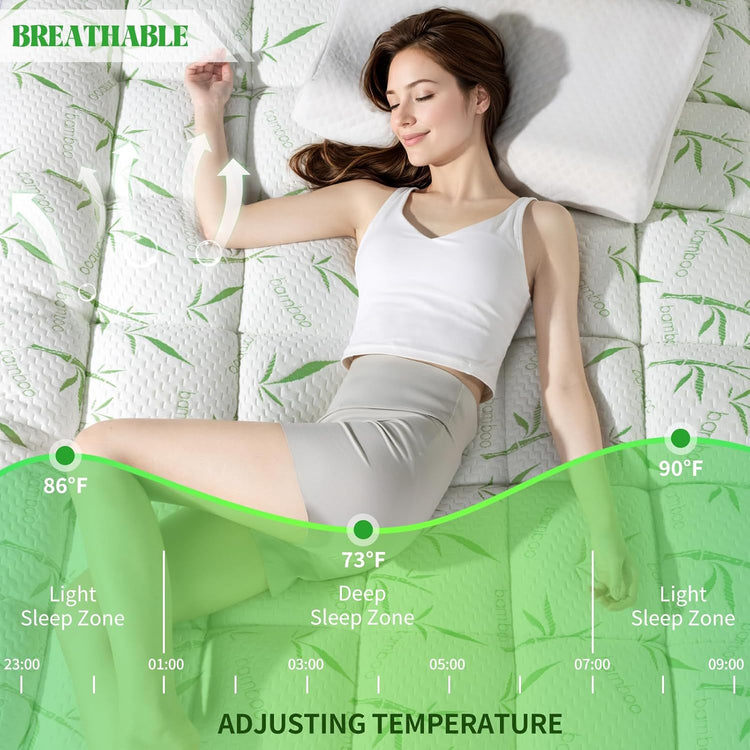
- Breathable bamboo cover to help reduce heat retention overnight
- Anti-slip backing keeps it securely in place on your existing mattress
- Universal fit for all standard mattress sizes
- 100-night money-back guarantee
HERE'S EXACTLY WHAT ORTHOBED CHANGES WHILE YOU SLEEP

Here is exactly how I think about it.
When you lay down on OrthoBed, I am not asking you to believe it somehow switches off your back pain in minutes.
I am asking you to change the surface your body has to lie against for the next seven or eight hours, then judge what happens in your own bed.
WHEN YOU FIRST LIE DOWN: THE CUSHIONING PHASE
The 4-inch comfort layer adds a meaningful barrier between your body and the mattress underneath.
That matters most around the places that absorb the most pressure overnight: the hip, shoulder, and lower back. Instead of meeting a hard or worn-down mattress surface directly, your body settles into a more forgiving top layer that begins distributing your weight more evenly from the first moment you lie down.
AS YOU SETTLE IN: THE POSITIONING PHASE
Morning stiffness can make finding a tolerable sleep position frustrating. One position feels fine for twenty minutes, then the hip starts aching. You roll over. The lower back complains. You shift again.
A more forgiving sleep surface gives you another variable to work with while you find the position your body actually wants to stay in for the night.
THROUGH THE NIGHT: CUSHIONING ON TOP, SUPPORT UNDERNEATH
OrthoBed does not replace the structure of your mattress. It sits on top of it.
So if your mattress still has good structural support but simply feels too hard or has compressed unevenly over the years, you keep the foundation underneath while changing the part your body actually presses against for every hour of the night.
WHEN YOU CHANGE POSITIONS: A MORE FORGIVING LANDING
People dealing with nighttime back and hip discomfort often reposition repeatedly through the night. Each turn puts the lower back, hip, and shoulder against a slightly different part of the bed surface.
The extra comfort layer is designed to cushion those high-contact areas so the mattress surface itself is less of a fight each time you settle into a new position.
BY MORNING: HERE'S WHAT YOU'RE ACTUALLY TESTING
Not whether a topper resolved every cause of your stiffness overnight.
You are looking for practical changes: Did you reposition less? Was it easier to stay comfortable? Did your hip and lower back feel less beaten up by the surface? Did the first twenty minutes of your morning feel any different from what they normally do?
THE RESEARCH DETAIL THAT MADE ME PAY ATTENTION
“In the past, doctors often recommended very firm mattresses. But one survey of 268 people with low back pain found that those who slept on very hard mattresses had the poorest sleep quality.”
Harvard Health Publishing, Harvard Medical School, “What type of mattress is best for people with low back pain?” (Feb. 12, 2021). health.harvard.edu
When I started looking at published guidance on sleep surfaces and morning back stiffness, one pattern kept appearing: the firmness and evenness of the surface underneath you during sleep is a variable worth testing before assuming an entirely new mattress is the only answer.
That is the role OrthoBed is being used for here: changing the sleep surface, not claiming to treat the medical cause of back pain or stiffness.
What I Want You To Notice Each Morning
- A softer, more forgiving top layer over the mattress you already own
- Extra cushioning around the hips, shoulders, and lower back where pressure concentrates overnight
- A surface that works with your preferred sleep positions rather than fighting against them
- The ability to change the feel of your bed without replacing the whole mattress first
- 100 nights to decide whether the change in sleep-surface comfort is meaningful for you
Let Me Show You What Chasing Better Sleep Really Costs Most People:
The "Just Buy A New Mattress" Route:
- Mid-range queen mattresses: $500 to $1,500 (average about $1,000)
- Premium or luxury models: $1,200 to $3,000+ (average about $1,800)
- Delivery, removal of the old mattress, and setup fees
- And you still do not know how it will feel at 2am until you actually sleep on it for a week
The Ongoing Chiropractic Route:
- Initial chiropractic consultation: national average $152 (range $121 to $281); follow-up visits average $76 ($60 to $140). Source: CareCredit, Chiropractic Costs
- Many people attend 8 to 12 sessions before deciding whether it is helping
- Plus travel time, appointment scheduling, and the cost continues if visits need to be ongoing
The Pain Management Route:
- Initial pain-management consultation without insurance: about $200 to $500+, with follow-up visits of $100 to $390. Source: thechiropractorr.com, pain management clinic costs (2026 data)
- Epidural steroid injection: cash prices of $597 to $1,484 per injection depending on facility and state (Sidecar Health cost data); pain clinics quote $600 to $2,000 per session (Hudson Pain Management, Aug. 2026)
- Costs can multiply if repeat visits or multiple interventions are recommended
The "Try Every Cheaper Solution First" Route:
- Heating pads, ice packs, pain creams: $20 to $80 each
- New pillows: $30 to $150
- Cheap thin foam toppers that compress within weeks: $40 to $100
- Over-the-counter pain medication used regularly: ongoing cost with no sleep improvement
And this is the part that started to frustrate me.
Not because any of those things are useless. For the right person in the right situation, some may absolutely have a place.
But if one real contributor to your morning stiffness is simply that the current mattress surface feels harsh and uneven against your hips and lower back for seven hours, I think replacing the entire bed is a very expensive first experiment to run.
WHEN A SIMPLE SLEEP-SURFACE CHANGE COMPETES WITH A VERY EXPENSIVE STATUS QUO

The more I looked at what people spend trying to get a better night's sleep, the harder one reality was to ignore.
Mattresses. Specialists. Procedures. Sleep clinics. Ergonomic pillows. Prescription sleep aids. It adds up.
Again, I am not telling you any of those options are wrong. Some are completely appropriate when a clinician believes they are necessary.
But I do not need a complicated theory to point out an obvious practical reality:
The common starting point for most people is either a very expensive purchase or a long, costly care pathway. A simple change to the surface you sleep on is almost too straightforward to get much attention first.
I would never tell you OrthoBed replaces medical evaluation or removes an underlying cause of back pain.
What I like about it is that it lets you test one much smaller, lower-cost variable first:
- Adds meaningful cushioning where the hip, lower back, and shoulder meet the mattress
- Works during the seven or eight hours you are actually in bed and most exposed to the surface
- Lets you change the feel of your sleep surface without replacing the mattress underneath
- Costs a fraction of even a mid-range mattress replacement
- Gives you 100 nights to decide whether the change is meaningful for your mornings
And that is the part the expensive routes cannot answer for you in advance:
What happens if you simply make the surface you lie on for seven hours more forgiving around the areas that keep waking you up stiff?
THE RESULTS THAT MATTER HAPPEN BETWEEN BEDTIME AND MORNING
What I can honestly say the available guidance supports
From the same Lancet trial: “Throughout the study period, patients with medium-firm mattresses also had less daytime low-back pain (p=0.059), pain while lying in bed (p=0.064), and pain on rising (p=0.008) than did patients with firm mattresses.” Kovacs FM et al., 2003. And from Harvard Health: “Considering that most people spend roughly a third of their lives lying in bed, choosing the right mattress is essential for managing low back pain.” health.harvard.edu
That does not prove a topper resolves every cause of morning stiffness. It does support the experiment OrthoBed is designed for: changing the sleep surface before committing to a far more expensive replacement.
So what do I want you to actually pay attention to during the 100-night trial?
- Do you spend less time shifting around looking for a comfortable position?
- Does the mattress feel less harsh around the hip and lower back?
- Are those first twenty minutes of the morning any different from what they normally are?
- Does your bed feel more forgiving without feeling like it has lost its support?
- Do your nights feel meaningfully more comfortable on the topper than without it?
Before I ask you to try it, here is what real OrthoBed customers are saying:
“We got talked into buying a firm mattress. I couldn't get comfortable, and started to get trigger points in my shoulders and hips. The mattress was stupid expensive so replacing it wasn't an option. I thought I would try a mattress topper, and bought this one. WHAT A DIFFERENCE!! I am so glad I bought this. It makes this miserable mattress a place I want to sleep. It's soft and inviting.”
Josh, OrthoBed customer review
“Living with chronic pain isn’t easy, but this topper made a huge difference. I’m now sleeping more deeply and waking up with less stiffness. Highly recommend for anyone with joint issues.”
Paul A., OrthoBed customer review
“The toppers as I bought 2 because I have a king sized bed two super twin mattress this was the only way I could get a harder mattress as it is a adjustable bed and now it’s much better for our backs my husband is 84 and I am 77 we both felt a huge difference the first night I recommend it if you’re looking for a firmer mattress”
Linda K., verified buyer, September 2026
THE AFFORDABLE ANSWER BEFORE A $2,000 MATTRESS EXPERIMENT

You want to know why I think this offer makes sense?
Because once I put the numbers next to each other, committing to a full mattress replacement before testing the sleep surface first started to look completely backwards.
A mid-range mattress can cost $1,000 to $2,000 or more. And people buy them, sleep on them for a week, and realise they feel different at home than they did in the showroom. By then the return window is often gone or the process is more trouble than it is worth.
So I would rather you do the smaller experiment first.
Test the surface variable. Then decide whether anything more expensive is even relevant to the sleep-surface problem you are actually dealing with.
- A fraction of the cost of even a budget mattress replacement
- Far less than a course of specialist appointments
- No delivery delay of weeks, no hauling the old mattress away
- And you test it on the bed you already own, with nothing to lose for 100 nights
Not a new mattress. Not another appointment. A simple 100-night test of one overlooked nighttime variable: the surface your hips, lower back, and shoulders are pressing against for seven hours every night.
I am not asking you to believe a mattress topper resolves every cause of back stiffness. I am asking a much simpler question:
What if making your existing bed more forgiving is enough to make your mornings meaningfully different?
CHECK AVAILABILITY NOWTHE CHOICE THAT COULD DEFINE YOUR NEXT 100 MORNINGS

Look. I understand the skepticism.
You have probably tried things before that sounded sensible and ended up making very little difference.
Maybe you have already changed your pillow. Tried sleeping in a different position. Used a heat pack before bed. Looked seriously at new mattresses. Maybe you have spent more than you want to think about and the mornings still feel the same.
So here is the promise I am comfortable making:
Put OrthoBed on the mattress you already own and give the sleep-surface change a fair test for up to 100 nights.
Judge the things that actually matter in your own bedroom:
- Does the mattress feel less harsh around your hip and lower back?
- Is it easier to find a position you can stay in without shifting?
- Do those first twenty minutes of the morning feel any different?
- Does your bed simply feel more forgiving without feeling like it has lost its support?
If the answer is yes: keep sleeping on it. You have changed one variable and your mornings have improved.
If the answer is no: use the 100-night money-back guarantee under the terms shown on the product page. Check those terms before ordering.

MY 100-NIGHT "MAKE THE BED MORE COMFORTABLE" GUARANTEE
I do not want you to decide whether this is the missing piece because of an article.
I want you to decide after sleeping on it for a meaningful stretch of real nights.
That is why the long trial matters. One night can be a fluke. A few weeks gives you enough real data from your own body, in your own bed, to know whether changing the top layer actually changes your mornings.
CHECK AVAILABILITY NOWWhat OrthoBed Customers Say
“I'm actually super estatic about the purchase of this mattress topper. The padding is soft, & fluffy. It was easy to put on as the bottom is stretchy almost like a fitted sheet. It's clean, & no bad smells. It exceeded my expectations. Hopefully, I get some good rest tonight as my mattress is 4 years old and firm. If I need to update I will but for now I'm pleased with this purchase.” John S.
“I run hot when I sleep, but this topper has completely changed that. The bamboo fabric really does stay cool all night. I wake up refreshed instead of sticky and uncomfortable.” Shanta
Common Questions
Does OrthoBed treat back pain?
No. OrthoBed is a consumer mattress topper. Morning back pain and stiffness can have several contributing causes and may benefit from professional evaluation. OrthoBed is intended to improve sleep-surface comfort, cushioning, and pressure distribution, not to diagnose or treat any medical condition.
Why talk about a mattress topper in an article about morning back pain?
Because the surface your hips, shoulders, and lower back are pressing against for seven or eight hours every night is a real and often overlooked variable. Changing the sleep surface is a practical, lower-cost experiment to try before committing to a full mattress replacement or a lengthy care pathway.
Which thickness should I choose?
OrthoBed is available in 2-inch and 4-inch options. The 4-inch version offers a more substantial comfort upgrade and is generally recommended for people dealing with persistent morning stiffness or hip and lower-back pressure. Check the current product page for availability and sizing details.
Will it fit my existing mattress?
OrthoBed uses universal sizing designed to fit all standard mattress sizes. Select the size that matches your current mattress when ordering.
Will it slide around during the night?
OrthoBed has an anti-slip backing designed to keep it in place on the mattress underneath. The cover is also fitted to reduce movement during normal sleep.
Will it make the bed too soft?
The multi-layer design is intended to provide a balanced feel: enough cushioning to reduce pressure at the hip, shoulder, and lower back, without removing the underlying support of the mattress beneath it. It is not designed to feel like a sinking or unsupported surface.
What if my symptoms are severe or getting worse?
Do not rely on a consumer sleep product. Seek qualified medical care, particularly for significant weakness, numbness, new bowel or bladder changes, or pain that is worsening rather than stable.
What does the 100-night guarantee actually cover?
Check the current terms on the live product page before ordering. Guarantee and return conditions are set by Home and Garden Trends and are subject to the terms shown at the time of purchase.
HERE'S EXACTLY WHAT TO DO NEXT
I am not suggesting you throw away your mattress tonight. And I am definitely not telling you that every cause of morning back stiffness comes down to the surface you sleep on.
But if you have been waking up stiff and sore for months and you have not yet tested the sleep surface itself, here is exactly what I would do next:
I am not asking whether a mattress topper can fix every cause of back pain. It cannot.
I am asking whether it makes sense to spend $1,500 or more replacing an entire mattress before you test the one variable you can change tonight for a fraction of the cost.
CHECK AVAILABILITY NOW
Kovacs FM, Abraira V, Peña A, et al. Effect of firmness of mattress on chronic non-specific low-back pain: randomised, double-blind, controlled, multicentre trial. The Lancet. 2003;362(9396):1599-604. https://pubmed.ncbi.nlm.nih.gov/14630439/
Harvard Health Publishing, Harvard Medical School. What type of mattress is best for people with low back pain? Feb. 12, 2021. https://www.health.harvard.edu/pain/what-type-of-mattress-is-best-for-people-with-low-back-pain
Sleep Foundation. How Much Does a Mattress Cost? Updated Jul. 15, 2025. https://www.sleepfoundation.org/mattress-information/how-much-does-a-mattress-cost
CareCredit. How Much Does a Chiropractor Cost? Pricing by Treatment. https://www.carecredit.com/chiropractic/costs/
Sidecar Health. Cost of epidural steroid injection by state. https://cost.sidecarhealth.com/ts/epidural-steroid-injection-cost-by-state
Hudson Pain Management. Pain Management Cost Without Insurance, Aug. 1, 2026. https://www.hudsonpain.com/blog/how-much-do-pain-management-procedures-cost-without-insurance
thechiropractorr.com. How Much Does It Cost to Go to a Pain Management Clinic? (2026 data). https://thechiropractorr.com/how-much-does-it-cost-to-go-to-a-pain-management-clinic/
Customer reviews quoted above are from the OrthoBed product page reviews (Judge.me) at garden-trend.store/products/orthobed. Cost figures are third-party published ranges at the dates shown and vary by region, provider and insurance.