5 Disturbing Things Hiding In Your Mattress Right Now, even If You Wash Your Sheets Every Week

For women over 35 who pride themselves on a clean home, this is the one surface that regular cleaning almost always misses.
You wash your sheets every week. You fluff your pillows. You run a vacuum over the surface of your mattress every now and then. Your bedroom looks and smells clean.
But here's a question that most women over 35 have never seriously considered: when did you last actually clean the inside of your mattress?
Not the sheets. Not the pillowcases. The mattress itself, the dense foam and fiber core you've been sleeping on for years. The place where, every single night, your body sheds around 30,000 to 40,000 dead skin cells per hour.
Sleep medicine specialists like Dr. Marsh have been raising this issue for years. And the findings are consistently unsettling. What lives inside a mattress, even a cared-for, regularly sheet-washed mattress, is far more than most people want to imagine. Here are the five most common, and most disturbing, things hiding in yours right now.

What's trapped inside mattress fibers goes far deeper than any sheet wash or surface vacuum can reach.
The human body is constantly renewing itself. As you sleep, your skin sheds a continuous layer of microscopic cells, roughly 30,000 to 40,000 per hour. Over the course of one night, that's several million cells. Over a week, tens of millions. Over a year? The math becomes genuinely hard to sit with.
Your sheets catch some of this. Washing them removes the top layer. But the cells that have already worked their way past the fitted sheet, vibrated down through the fabric weave by your body weight and movement during sleep, are already embedded in the mattress itself.
A standard sheet wash can't reach them. A quick surface vacuum doesn't have the agitation mechanism to dislodge them from deep within compressed foam and fiber. They accumulate, year after year, layer by layer.
For women over 35 who put real effort into keeping a clean home, this is the gap that doesn't get talked about. Your sheets are clean. Your mattress almost certainly isn't.

A spotlessly made bed can house a thriving dust mite colony. They don't need to be visible to trigger your symptoms.
Where dead skin cells accumulate, dust mites follow. They are microscopic arachnids, not visible to the naked eye, and a typical mattress is estimated to house between 100,000 and 10 million of them at any given time. They are not a hygiene failure. They are a consequence of having a mattress that has never been properly deep-cleaned.
The mites themselves don't bite. The problem is their waste. Dust mite fecal particles, and there are thousands produced per mite per day, are one of the most potent indoor allergen triggers known. When your body compresses the mattress during sleep, those particles become airborne. You breathe them in for 7 or 8 hours.
If you regularly wake up congested, stuffy, or sneezing before you've even had your coffee, this is the most likely culprit. Your house isn't dirty. Your mattress is just doing what all mattresses do when they've never been properly extracted, providing the perfect warm, humid, food-rich environment for mites to thrive.
Regular vacuuming helps with loose surface debris. It does almost nothing to dislodge mite colonies and their waste from deep within compressed mattress fibers. That requires a different approach entirely.
Even if your dog only sleeps at the foot of the bed, dander travels. Once it's in the mattress fibers, surface vacuuming leaves it exactly where it is.
If you have a dog or cat, and a large proportion of women over 35 do, pet dander is almost certainly embedded in your mattress. Dander is not pet hair. It's microscopic flakes of dried skin protein shed continuously by animals, and it is significantly smaller and lighter than dust. It drifts, settles, and works its way into fabric surfaces with far more ease than most people realize.
Pet dander is also one of the most clinically significant indoor allergens for adults. It doesn't matter whether your pet sleeps on the bed or on their own bed across the room. Dander is airborne, and it settles on every fabric surface in the room, including, and especially, the mattress you sleep on for a third of your life.
Here's what makes this particularly difficult: pet dander particles are so small and light that they lodge between individual mattress fibers rather than sitting on top of them. A regular upright or canister vacuum, even one with good suction, primarily removes what's on the surface. The dander trapped inside the fibers remains.

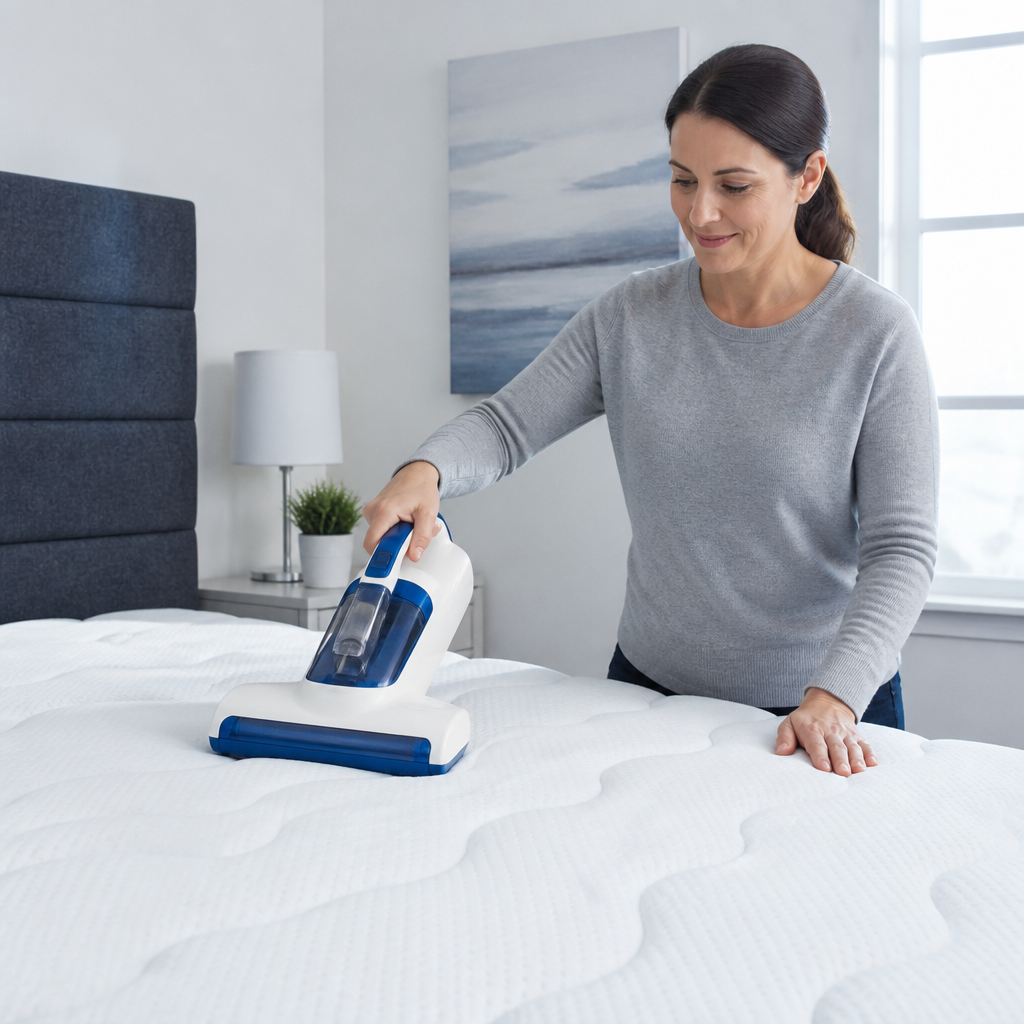
A purpose-built mattress vacuum uses beating and vibration action to dislodge debris that standard vacuums leave behind.
Body hair is shed constantly during sleep. So are fine textile fibers from your sheets and nightwear. So is the faint residue of lotions, skin oils, and anything else your skin produces through the night. Over weeks and months, these accumulate in the upper layers of the mattress, in a zone that a quick surface vacuum passes over without genuinely extracting.
The problem is compounded by the mattress's structure itself. The dense foam and fiber core is designed to support body weight, which means it also compacts and holds debris. Every time you lie down, you're pressing that buildup a little deeper into the fabric. Every time you run a standard vacuum over the top, you're skimming the surface of what's actually there.
This is why sleep specialists increasingly draw a distinction between surface cleaning and deep extraction. Surface cleaning, washing sheets, wiping down the mattress protector, addresses what you can see and smell. Deep extraction addresses what's accumulated in the layers below, the zone that feeds dust mite colonies and keeps allergen levels elevated no matter how often you wash your bedding.
For women over 35 who take cleaning seriously, this is the frustrating blind spot. You're doing everything right on the surface. But without a tool specifically designed to agitate and extract from inside the mattress fibers, you're cleaning the wrapper and leaving the filling untouched.

What a proper extraction clean feels like the morning after, a noticeably cleaner environment and a better night's sleep.
Your body loses around half a litre of moisture per night through perspiration and respiration. Most of that evaporates. But some is absorbed by your mattress, creating the warm, slightly humid internal environment that dust mites specifically require to survive and reproduce. Standard vacuums don't address this. They have no mechanism to treat the internal environment of the mattress, only to remove loose debris from its surface.
The finest particles, sub-micron allergens, broken-down skin cell fragments, mite waste, are also simply too small and too embedded for a regular vacuum head to dislodge. A standard floor vacuum is engineered for hard surfaces and carpet. Its suction profile, head design, and lack of agitation make it genuinely unsuited for the task of extracting trapped particles from the dense fabric surface of a mattress.
This is not a criticism of your vacuum. It's the right tool for floors. It's the wrong tool for a mattress, and no amount of diligent use will make it otherwise. Without an agitation mechanism specifically designed to loosen embedded particles before suction pulls them out, a large proportion of what's accumulated inside your mattress simply stays there, regardless of how often you run a cleaner over the surface.
That's the core problem. And it's why a growing number of women over 35 are moving beyond surface cleaning and toward a purpose-built solution.
That's Why 7,300+ People Switched to a Purpose-Built Mattress Extractor This Month Alone
Once you understand the distinction between surface cleaning and genuine deep extraction, the case for a dedicated mattress vacuum becomes obvious. Not more suction, a different process entirely. One built around the specific challenge of loosening embedded particles from dense mattress fibers before removing them.
The Home & Garden Trends Mattress Vacuum Cleaner was engineered specifically for this task. Its design combines high-frequency beating action with powerful suction so that debris is first agitated loose from the fiber structure, then captured, not just skimmed from the top layer.

The transparent dust cup is one feature customers specifically mention. You can see exactly what's been extracted, the fine gray powder of accumulated skin cells, allergen particles, and debris that your mattress has been holding for months or years. It's the visible proof that the process works, and for many women, it's the moment they realize how necessary this had been.
This is not a luxury purchase. It's the tool that makes the cleaning routine you're already doing actually complete.
What the Home & Garden Trends Mattress Vacuum Cleaner Does That Ordinary Vacuums Can't
- High-frequency beating action dislodges particles embedded deep in mattress fibers before suction removes them
- Ultrasonic vibration reaches into compressed foam and fiber layers that a standard vacuum head glides over
- 253.7nm UV-C light helps treat the mattress surface for hygiene, an additional step that a regular vacuum has no equivalent for
- 145°F hot air function helps address the internal moisture environment that dust mites depend on
- Anti-tangle double roller brush engineered specifically for soft fabric surfaces, not hard floors
- Multi-stage filtration captures fine allergen particles so they go into the dust cup, not back into the air
- Transparent dust cup shows you exactly what's been extracted, visible proof of what your mattress was holding
- Lightweight and easy to maneuver across an entire mattress surface without strain
- Suitable for mattresses, pillows, upholstered sofas, and pet beds, anywhere soft fabric accumulates hidden debris
- No consumable refills, no chemicals, a one-time investment in genuinely complete bedding hygiene
How the Deep-Bed Extraction Process Works
Step 1: Loosen
High-frequency beating action and ultrasonic vibration shake embedded particles loose from deep within mattress fibers, the step that standard vacuums skip entirely.
Step 2: Lift
Powerful suction immediately captures the dislodged debris before it resettles, pulling dead skin cells, allergens, and fine particles up and away from the mattress surface.
Step 3: Treat
253.7nm UV-C light and 145°F hot air treat the surface and address the warm, moist environment that allows dust mite colonies to establish and thrive.
Step 4: Capture
Multi-stage filtration locks captured particles into the transparent dust cup, so you see exactly what was in your mattress, and none of it goes back into the air you breathe.
What Women Over 35 Are Saying
"I've always considered myself house-proud. Sheets washed every week, bedroom vacuumed regularly. When I first used this on my mattress, a mattress I thought was fine, the dust cup was full of fine gray powder. I genuinely could not believe that had been in there. My morning congestion has completely gone."
"I was skeptical at first: I thought it couldn't really be that different from running my regular vacuum over the mattress. It is completely different. The beating action is the key. You can feel it agitating the surface, and what it pulls out is proof that an ordinary vacuum just wasn't getting to this layer. My allergies are noticeably better in the mornings."
"We have two dogs. They don't sleep on the bed, but the dander obviously does. I'd been waking up stuffy for so long I'd almost stopped noticing. Three weeks of using this once a week and I'm sleeping through the night without any congestion. I genuinely wish I'd known this existed years ago."
"I bought this for the guest room mattress which is about 8 years old. What came out of it was disgusting, in the best way, because at least it's out now. The transparent dust cup is clever because you can actually see the result. My guests are sleeping on a properly clean bed for the first time in years."
"My daughter has mild asthma and her bedroom mattress was the one thing we'd never properly dealt with. After the first use I could see immediately what had been in there. Her nighttime symptoms have been so much less since we started doing this weekly. It's become a non-negotiable part of the cleaning routine now."
We cannot guarantee availability after today.
Secure checkout · Free shipping available · 90-Day money-back guarantee
VISA | AMEX | PayPal | Apple Pay | Google Pay | Afterpay